Building a dashboard for options trading
TIMELINEJul 2025 - Aug 2025
ROLEFullstack Developer
TECH STACKNext.js, TypeScript, FastAPI, Supabase
SKILLSProduct Design, Vibe Coding, Options Trading
OVERVIEW
From trading frustration to fully functional product
I built a comprehensive options trading platform that combines real-time gamma exposure analysis with historical volatility statistics. The project started as a personal tool to solve specific pain points I faced while trading options full-time, and evolved into a polished product that I'm now packaging as a SaaS.
This was a vibe-coded project—I architected the system, made all technical decisions, and directed the implementation, leveraging AI agents to handle the heavy lifting of development. It proved to me that I can take any concept from idea to fully functioning product if it meaningfully improves an aspect of my life.
THE PROBLEM
Flying blind in a data-heavy market
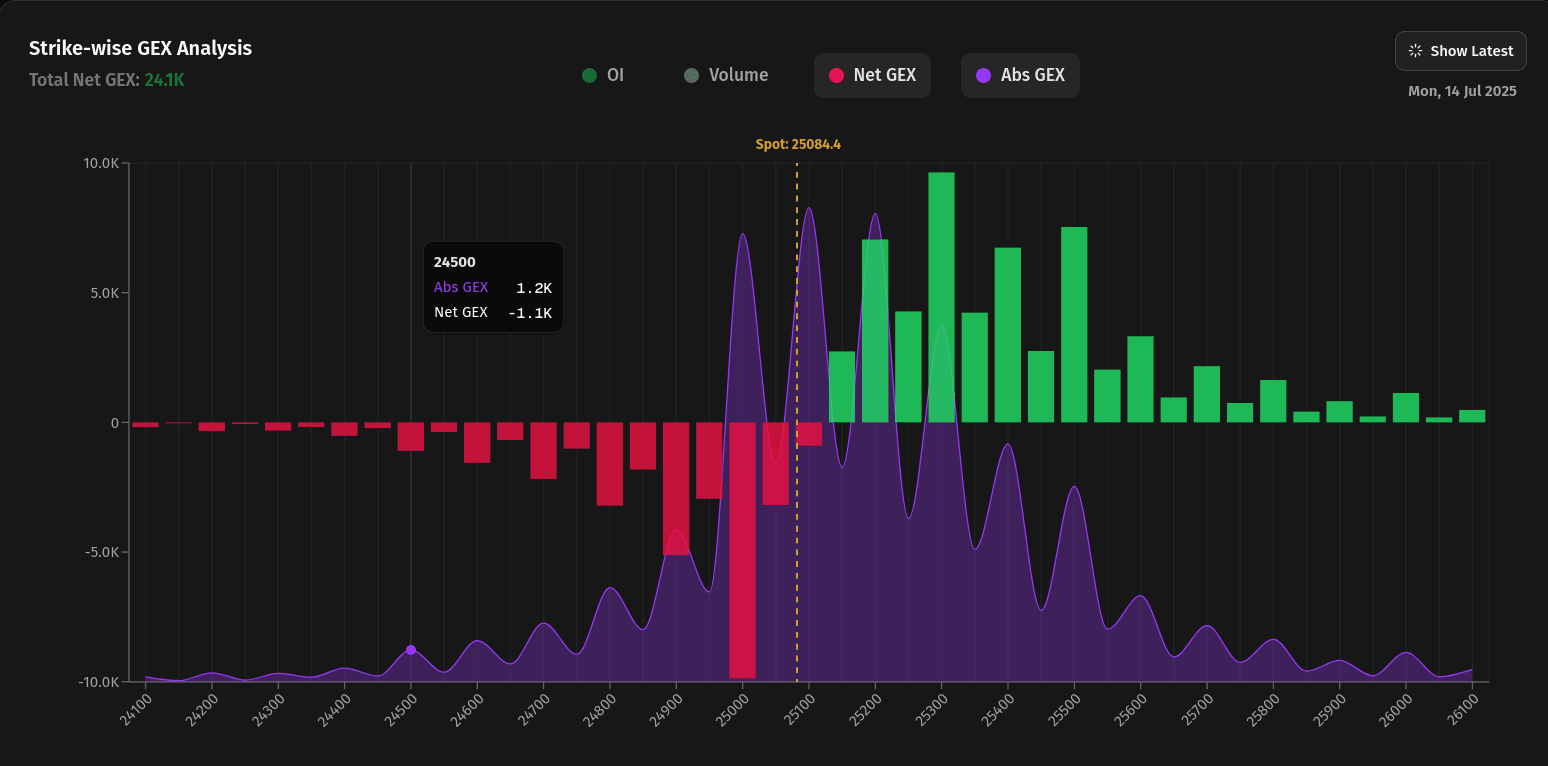
While trading options full-time in the Indian markets, I kept running into the same frustrations. There was no accessible way to visualize strike-level gamma exposure for NIFTY and BANKNIFTY. I needed to see where the gamma walls were—those strike prices where heavy options positioning creates magnetic effects on price—but existing tools were either too expensive or lacked the granularity I needed.
I also wanted to understand how OTM Greeks behaved intraday. How were sellers and buyers repositioning through the session? Where was the risk concentrating?
Separately, for my positional trades, I was selling option spreads based on intuition about how far price might move. I needed statistical grounding—actual standard deviation data on candle ranges, gaps, and body sizes—so I could set realistic expectations and avoid panic exits when price moved within normal ranges.
THE SOLUTION
Two tools, one seamless platform
I decided to build exactly what I needed. The platform combines two complementary tools:
Intraday GEX and Greeks Analysis
A real-time dashboard showing strike-wise gamma exposure, net GEX variation throughout the trading day, and OTM Greeks tracking for NIFTY and BANKNIFTY. Features a time slider to replay intraday changes and see how positioning evolved.
A real-time dashboard showing strike-wise gamma exposure, net GEX variation throughout the trading day, and OTM Greeks tracking for NIFTY and BANKNIFTY. Features a time slider to replay intraday changes and see how positioning evolved.
Positional Statistics
Standard deviation-based analytics for any ticker, showing expected ranges for total moves, body sizes, gaps, and net changes across custom lookback periods.
Standard deviation-based analytics for any ticker, showing expected ranges for total moves, body sizes, gaps, and net changes across custom lookback periods.
I started with the GEX tool first, building it part-time over a month—coding during market off-hours, testing during live sessions, refining based on what actually helped my trading. The statistics tool began as a quick Streamlit prototype for personal use, then got promoted into the main platform when I realized how much I depended on it daily.
HOW I BUILT IT
Concept to product without writing every line
I architected the entire system from scratch—designing the data pipeline, database schema, API structure, and frontend components—but used AI coding agents to implement the heavy lifting. This let me move fast without getting bogged down in implementation details.
Key decisions I made:
- Real-time data pipeline pulling from Dhan API every minute during market hours
- Dual-storage strategy keeping recent data at full granularity while rolling up older data to manage costs
- Strike filtering to focus only on relevant strikes near the money, keeping the interface clean and queries fast
- Pre-computed metrics calculating all GEX values at ingestion time so the frontend stays responsive
- Unified interface bringing both tools into a single Next.js application with consistent design
The result is a production-grade platform that handles tens of thousands of data points per day, serves real-time visualizations, and fits comfortably within free-tier database limits through smart architecture.
HOW I TRADE WITH IT
Replacing gut feeling with context
Before taking trades: I check the positional statistics to see what "normal" looks like. If I'm selling a spread, I want to know the 1-sigma and 2-sigma ranges for the day. This sets realistic expectations and prevents me from chasing moves that are statistically unlikely.
During the session: I monitor the strike-wise GEX to identify absolute gamma walls—strikes with high concentration that often act as price magnets or hard resistance. I avoid entering when price is moving toward a wall, and position aggressively when price moves away from one toward areas of positive net GEX.
Managing positions: The intraday OTM Greeks tracking shows me how sentiment is shifting through the day. Seeing vega and theta build up in out-of-the-money options tells me where the crowd is positioning and whether the risk profile is changing.
Emotional regulation: The biggest edge hasn't been any single trade—it's been the calm that comes from knowing whether a move is within normal statistical bounds or actually an anomaly worth reacting to. When price moves against me but stays within the 1-sigma range, I hold. When it breaches 2-sigma, I reassess.
REFLECTION
Building as a skill multiplier
This project proved that I can identify a gap in my own workflow, design a complete technical solution, and ship a functioning product without being limited by my manual coding speed. By leveraging AI for implementation while retaining full control over architecture and design decisions, I built something that paid for itself many times over through better trading outcomes.
The platform kept me grounded in fast-moving markets and consistently helped me avoid bad trades while identifying high-probability setups. More importantly, it confirmed that if a tool doesn't exist to solve my specific problem, I can build it—from concept to design to deployment.